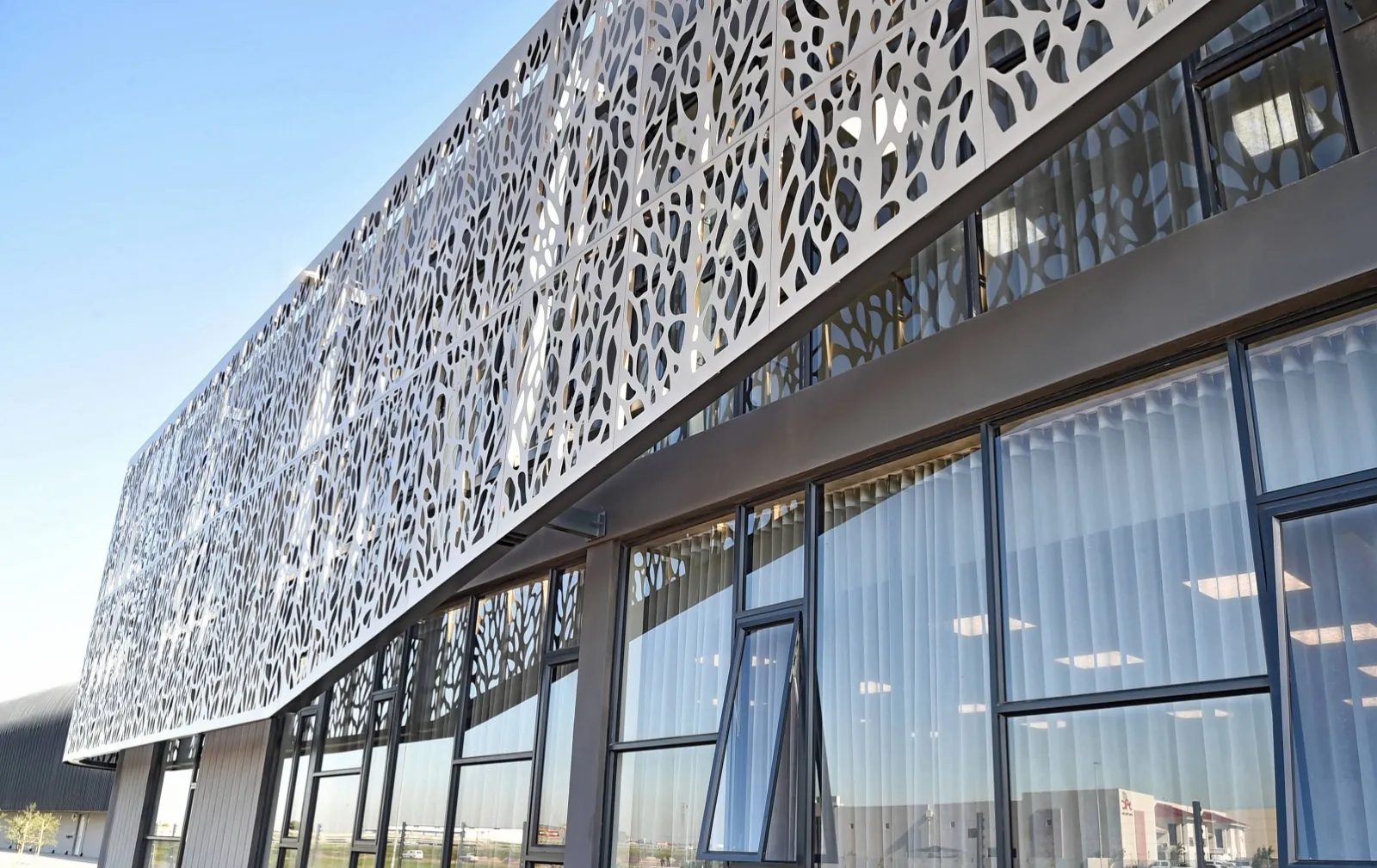
Flat panels give a flush face with a 3mm gap. Tray (cassette) panels give a 15mm shadow gap and a tiled look. Panel sizes, fixings, corners and sub-frames compared.
Every perforated aluminium facade we make is fixed one of two ways: as a flat panel or as a tray, also called a cassette. The choice changes how the facade looks, how big each panel can be and how the corners are detailed, so it is worth settling early in the design.
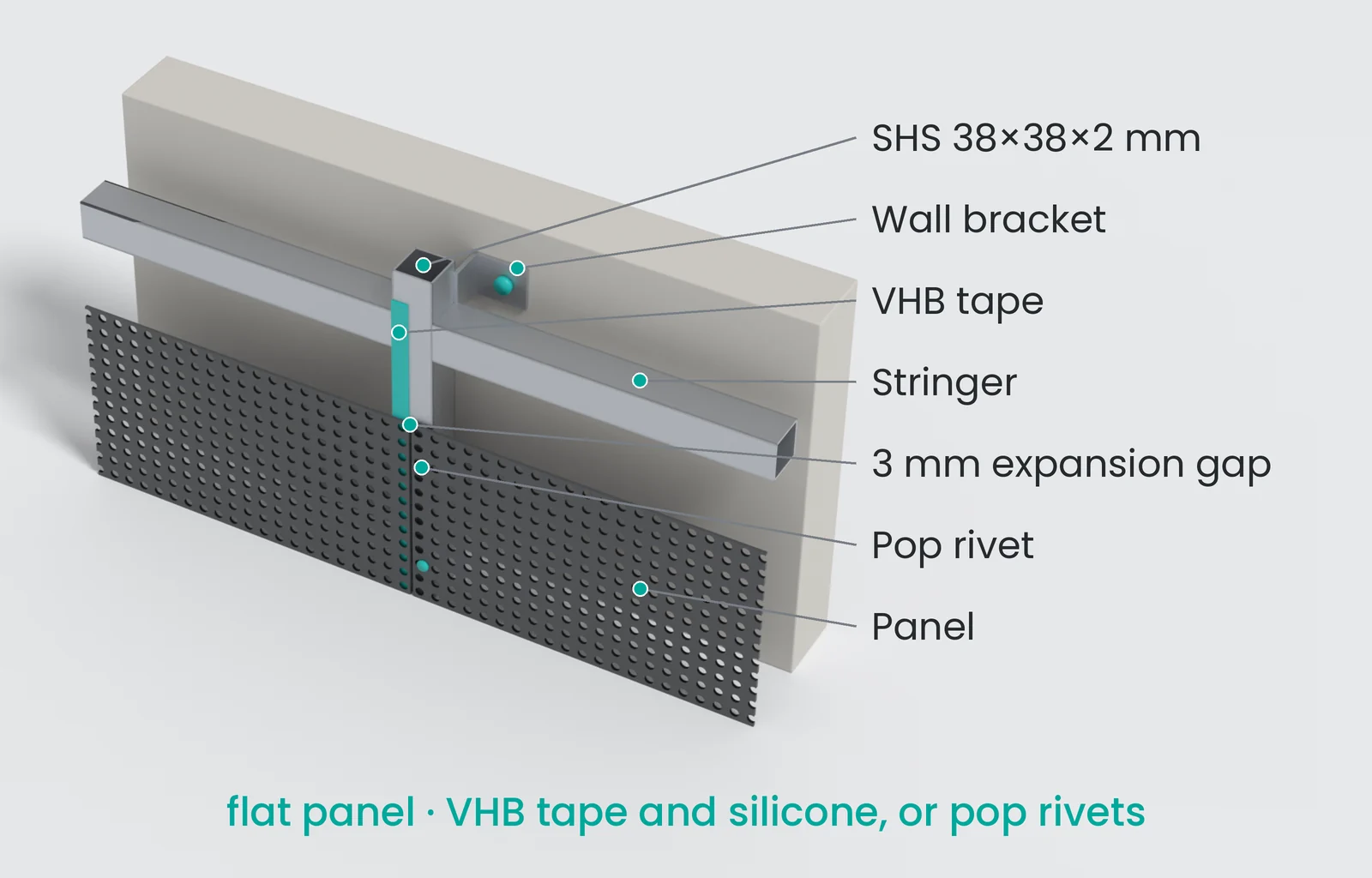
Images are illustrative renders of TILT's fixing details, not photographs of installed panels.
A flat panel is a single perforated sheet fixed to a tubular aluminium sub-frame. Depending on location and exposure, we fix it with VHB tape and structural silicone, or with pop rivets. The face is flush, with a 3mm expansion gap between panels.
A tray panel has its edges folded back to form a shallow box, 40mm deep. It is fixed to the sub-frame with aluminium angle brackets, which leaves a 15mm shadow gap between panels.
Flat and tray panels can both meet at a corner with a butt joint. Tray panels can also use a bird beak joint, where the two folded edges meet at the corner to give a crisper line. If the corners are a feature of the design, that is a reason to lean towards tray panels.
Both systems sit on the same sub-frame: a grid of vertical and horizontal aluminium stringers fixed back to the wall or structure with aluminium angle or U-brackets. We use 38 x 38 x 2mm SHS at panel joins and 38 x 38 x 3mm aluminium angle as mid-supports on larger panels. The sub-frame and fixings can be colour-matched to the panel where the budget allows, which matters on perforated work because the sub-frame shows through the holes.
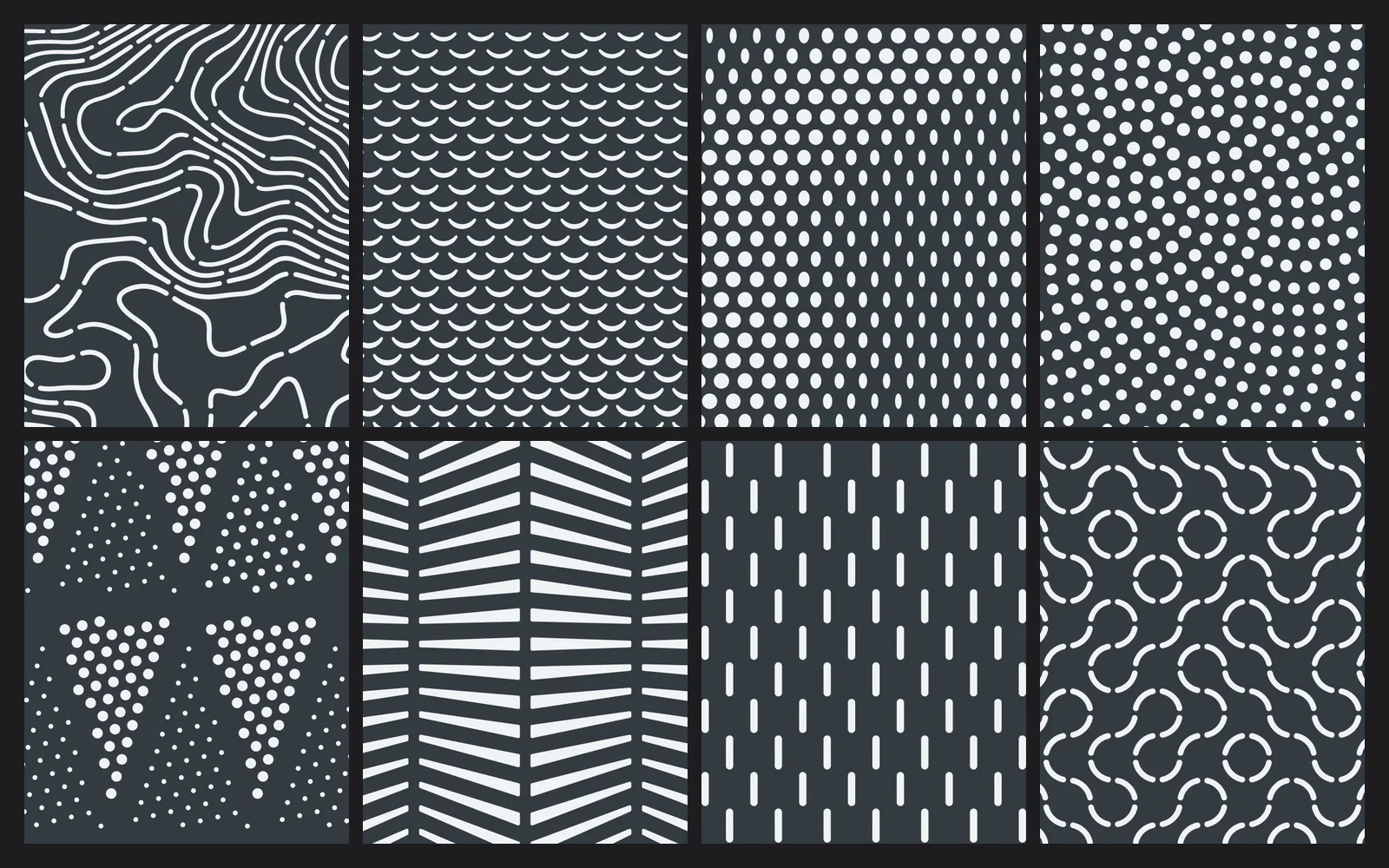
Panel size, fixings and sub-frame are always checked for the wind load and exposure on your site before we make anything. See the full details on our aluminium perforated panels page, browse the pattern library, or send us your drawings and we will recommend a fixing.
Yes. Some projects use tray panels on a main elevation and flat panels where the facade becomes a screen. We detail the junction between them on the shop drawings.
On flat panels fixed with VHB tape and structural silicone, no fixings show on the face. Pop rivets and angle brackets can be colour-matched to the panel.
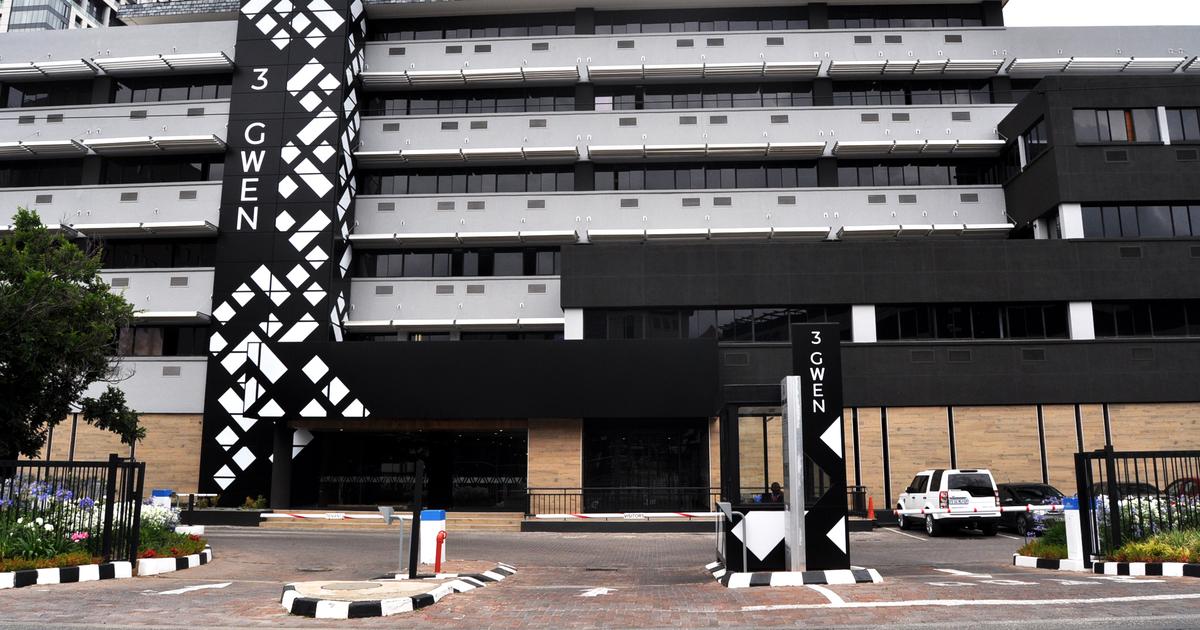
See how TILT delivers cladding and facades in Cape Town, Johannesburg and Durban.