Everything an architect needs to know about material thickness, perforation patterns, open area percentages and fixing systems.
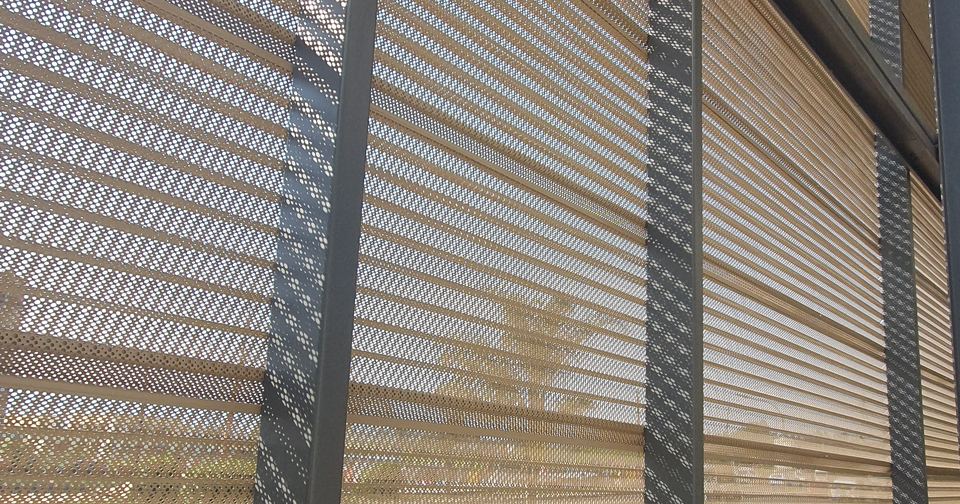
Perforated aluminium screens are one of the most versatile tools in the architectural specifier’s toolkit — but getting the specification right requires understanding how material, perforation pattern, open area percentage and fixing system all interact. All TILT screens are manufactured from structural-grade aluminium in our Cape Town workshop.
For exterior applications, 2mm aluminium is the standard minimum. For structural screen walls or large unsupported spans, 3mm is recommended. Mild steel can be specified from 2mm but requires appropriate primer and topcoat for exterior use. For coastal projects, review our maintenance and finish guide to understand the durability implications of material and finish choices.
Open area percentage directly affects solar shading performance, privacy, structural rigidity and wind loading. A 30–40% open area gives a good balance of privacy and light transmission for most residential and commercial applications. Higher open area (50%+) is appropriate for purely decorative or shading applications where privacy is not the primary requirement. Browse our pattern library to compare open area percentages and pattern types, or read our guide on how to choose the right pattern.
For exterior aluminium, powder coat to Qualicoat Class 1 or 2 standard is the benchmark. For coastal environments within 1km of the sea, specify marine-grade anodising or Qualicoat Class 2 as a minimum. Our multi-perforated panels (MPP) are available in the full Dulux Powder Coat range — browse all colour and finish options.
Face-fixed, bracket-fixed and concealed clip-fix systems are all available. Concealed systems produce a cleaner visual result but require more precise subframe tolerances. For large-scale commercial facades, concealed systems are strongly recommended. See how different fixing approaches look in our completed projects.
TILT provides full specification support — shop drawings, structural calculations, material data sheets and NBS-format specification clauses. For ACP-backed or composite panel applications, see our ACP material page for combined system specifications. All documentation is available to download from the Specifiers Portal.
Start a conversation to discuss your project requirements.